Walleye Fishing 2026
Walleye numbers in Lake Erie soar to new record levels
Lake Erie walleye fishing Port Clinton, Ohio to be as good as the haydays of the 70’s 80,s and 90’s


Walleye fishing on Lake Erie
Anglers can expect great walleye fishing in Lake Erie to continue following another exceptional hatch in 2025.
Although the yellow perch hatch was below the long-term average, anglers in the western basin of Lake Erie can expect some seasonally good fishing for yellow perch during the summer of 2026.
Data from annual trawl surveys conducted by the Division of Wildlife are combined with those collected by the Ontario Ministry of Natural Resources and Forestry to indicate the combined success of spawning and early life survival of walleye and yellow perch in the western basin. In the central basin, Ohio’s trawls are used in conjunction with other agency surveys to gauge hatch success.
Results allow biologists to estimate how many young fish will enter the catchable population two years later. These indices are a key piece of information used by the inter-agency Lake Erie Committee of the Great Lakes Fishery Commission to determine annual levels of safe harvest for walleye and yellow perch.
Walleye
In an unprecedented run of great walleye hatches, four of the survey’s top five hatches have occurred during the past six years. The 2023 western basin walleye hatch index was 132 fish per hectare (a standard measure of catch per area), well above the average of 56, the fifth largest in the survey’s 36-year history.
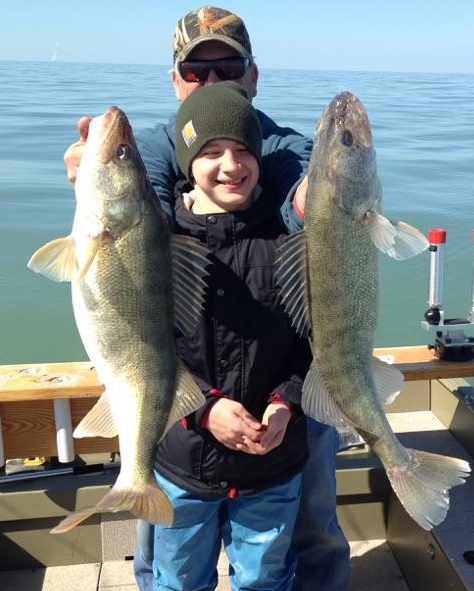
The walleye population in Lake Erie has exploded during the past few years — the fishing is considered to be great, and fisheries managers say it will only get better every year as younger fish grow. There are now big numbers of 5 and 6 year old walleye 20 to 28 inch!
“We just had, based on our trawl survey, the best hatch we’ve ever seen,” said Travis Hartman, Lake Erie administrator at the Ohio Division of Wildlife’s Sandusky Research Station. “We’re very pleased.”
Where do walleye spawn, and when?
Walleye spawn when water temperatures rise above 40 degrees, usually in late March or early April. They often spawn in shallower waters, such as bays and rivers like the Sandusky and Maumee.
Gravelly, sandy or rocky bottoms are ideal sites for females to broadcast eggs – up to 400,000. But the majority of Lake Erie walleye actually end up spawning on shallow reefs and nearshore waters in the lake proper, where males follow quickly behind egg-spreading females, eager to spread their love, too. Walleye tend to return to the sites where they were hatched to spawn.
Once eggs are fertilized and larval walleye develop on their spawning beds they’ve only a short window to make it or die, Hartman explained. After just a little more than a week when they are self-feeding, still inside tiny yolk sacs, they bust out. And they’re hungry.
“They need zooplankton (microscopic organisms) to eat and to survive. Right after they hatch from the sacs,” Hartman said. “But they need food and need it where they are right away.” If the zooplankton aren’t there, the tiny fish are doomed
Can wildlife managers influence the walleye population?
No one has much control over zooplankton or walleye in Lake Erie’s roughly 10,000 square miles. The only control fisheries managers have over walleye populations, Hartman said, is harvest limits. Those levels, he said, have only been tweaked minimally in recent decades.
Prior to 2001, the limit had been 10 fish per angler per day, all year long. But biologists then realized the given walleye population couldn’t support such creel limits. “It was definitely reflective of the population,” Hartman said. “Things were looking pretty bleak at the time.”
It was then Ohio Division of Wildlife managers decided to cut the daily limit, per angler, to six fish. And they cut the limit even further during the spring spawning period, to just four fish per day. While anglers in general weren’t necessarily happy, they knew it was for the best.
During some years the hatch has been virtually non-existent. In 2002 and 2004, the trawl netted virtually no new walleye. The one trend that has caught biologists’ attention is that colder winters, especially those with significant ice coverage in the Western Basin, seem to help the hatch.
While the term “hatch” is applied regularly to trawl survey results, it may not be exactly accurate, Hartman said. That’s because the number of walleye that hatch could never be counted, since they’re too tiny to be counted.
What fisheries managers are really counting and calculating through trawls is the number of walleye that survived the spring and summer and made it to the lake. Those fish are termed young-of-year, and they’re the ones counted annually when they get scooped up in the scientific sampling.
Walleye are Lake Erie’s economic engine
With 700-plus charter boats operating on Lake Erie, the vast majority in the Western Basin, charter fishing is big business on the lake and walleye – the big-eyed, toothy predators – are target No. 1.
Ohio Division of Wildlife statistics indicate that between charter and private boats, nearly 700,000 fishing trips take place on the lake each year on Ohio waters. Add a couple hundred thousand for Michigan, Ontario, Pennsylvania and New York. Estimates of Ohio’s Lake Erie sportfishing and associated expenditures, which include bass and yellow perch efforts, top $1 billion annually.
That’s music to the ears of Larry Fletcher, president of Lake Erie Shores & Islands, who is tasked with promoting tourism in Ottawa and Erie counties at the western end of Ohio’s lakeshore.
“We don’t consider these numbers an invasion,” Fletcher said about the massive influx of new fish. “We want the walleye. I don’t think we’ll ever find a time when there are too many walleye in the lake.”
According to Fletcher, he was happy when he got wind of the 2015 hatch. “And now we get word that this 2018 hatch rivals both of these, and is likely even better,” he said. “They don’t call this The Walleye Capital of the World for nothing.”
(Full disclosure: Baudette, Garrison, Isle, Ray, and Rush City, Minn., Garrison, North Dakota, Umatilla, Ore., Mobridge, South Dakota, and Shell Lake, Wisc. also claim to be “The Walleye Capital of the World.)
Fletcher said people from all over the nation travel to fish Lake Erie. “It’s the go-to place for walleye. In the spring we get anglers from Wisconsin, North Dakota, South Dakota, Iowa, Illinois, New York, Pennsylvania – you name it.”
In addition to charters and everyday anglers, the lake’s walleye population also draws tournaments which attracts hundreds of out-of-state anglers and plenty of news coverage each year. All great for the economy, Fletcher said, and Lake Erie’s reputation as the true Walleye Capital of the World. And he emphasized the word “true” with a steady conviction.
How do biologists know how many walleye there are?
Each year, fisheries managers in Ontario and Ohio get together to figure out how many new walleye there are in Lake Erie. They use bottom trawls to check out how many tiny walleye they pull from the lake’s bottom. They target, in late summer and early autumn, the fish that hatched earlier in spring.
“In the trawls, nets get dropped to the lake’s bottom for 10 minutes,” Hartman explained. “Slowly, boats move along for 10 minutes, then pull the nets.” The current trawl survey model has been used since 1987,” he said.
The Division of Wildlife’s 2018 trawl found 112 walleye per hectare (about 2.5 acres.) That’s the second-highest number on record and far above the 20-year average of 27 walleye per hectare in Ohio waters. Ohio biologists conduct about 40 trawls in the Western Basin.
Initial reports from trawls conducted by the Ontario Ministry of Natural Resources & Forestry in Ontario waters showed similar results. In fact, Richard Drouin, lead management biologist with OMNRF, said they’re more than happy with the results.
“Walleye numbers for us based on our survey are at an all-time high,” he said. “We sampled 36 sites on our side and we use the same protocol as Ohio.”
Fisheries managers with Ontario and the other Lake Erie states will meet in late winter to set the total allowable catch for the next season. For Canada, that means mostly commercial fishermen will pull ‘eyes form the lake. “Our sport angling fishery is nowhere near the size of Ohio’s,” Drouin said.
In Ohio commercial netting of walleye is prohibited – walleye are taken only by hook and line anglers.
Drouin said biologists are especially pleased because numbers have been high for multiple years. “It’s been a long time since we have had re-occurring recruitment from the spawns,” he said, going on to explain that it offers anglers and commercial fishermen a steady stream of catchable fish. “I think what we’re looking at here is a really healthy population of walleye and it should provide good fishing for years to come. I wish we could take credit for it but it was all Mother Nature.”
Based on models of the combined research efforts, Hartman speculated, there could be a population of 130 million walleye in the lake. Or more.
Lake Erie 2026 Walleye Fishing like The Good Ole Days
PORT CLINTON — We all love to talk about the glory days and recall with excitement those snapshots off the calendar we consider the best of times. We relish the memories and relive those periods when it seemed like the planets were perfectly aligned, the sun always was shining, the fish were biting, and the harvest was overwhelming.
Usually, the predominant thought is it was a rare phenomenon, and we never will experience such exhilaration again, or live to see another sequence of such unlimited excellence. But that might not be the case for those anglers that make Lake Erie their home turf and walleye their fish of choice.
In recent years, when Erie’s walleye fishermen would harken back to the bounty of fish they encountered during the walleye boom of the 1980s and 1990s, they would speak wistfully, as if that explosion of fish was a one-time event, sparked by the ban on commercial fishing for walleye in Ohio waters put in place in the late 1970s.
Now, those same anglers are looking for a repeat — another walleye gold rush — and they see it out there on the horizon.
“The good old days start this year,” exclaimed charter captain Eric H. “The future of walleye fishing in Lake Erie for the next five to seven years is going to be fantastic!”
The reason for that unbridled optimism, an enthusiastic opinion shared by many, is most of the fish from a couple of outstanding hatches in recent years have now matured into “keeper” size walleye at 15-inches or more in length. While many anglers were temporarily frustrated by all of the small fish in the catch this past summer — there were days where boats went through 100 walleye hook-ups just to see 20 legal-size fish — their frustrations should transform into coolers full of satisfaction in 2018, and beyond.
“We saw definitive proof about a really bright future,” said Hirzel.
Toledo native and walleye pro-Ross Robertson had to chuckle this past season each time he heard about the “problem” with all of those small fish out in the lake, knowing what was just around the corner as those young fish fed aggressively and grew quickly.
“Those fish are now 16-to-17 inches long, and according to state, there was more than 100 million of them, just in the 2015 hatch alone,” “Most of those throwbacks are now all legal. I think the good problem we will have now is catching the trophy-size fish Lake Erie is known for, with all of these Erie-size ‘eaters’ we now have out there.”
Travis Hartman, who makes monitoring and preserving world-class fishery his life’s work as the Lake Erie Program Administrator for the Ohio Division of Wildlife, said the 2015 walleye hatch is one of the largest ever studied.